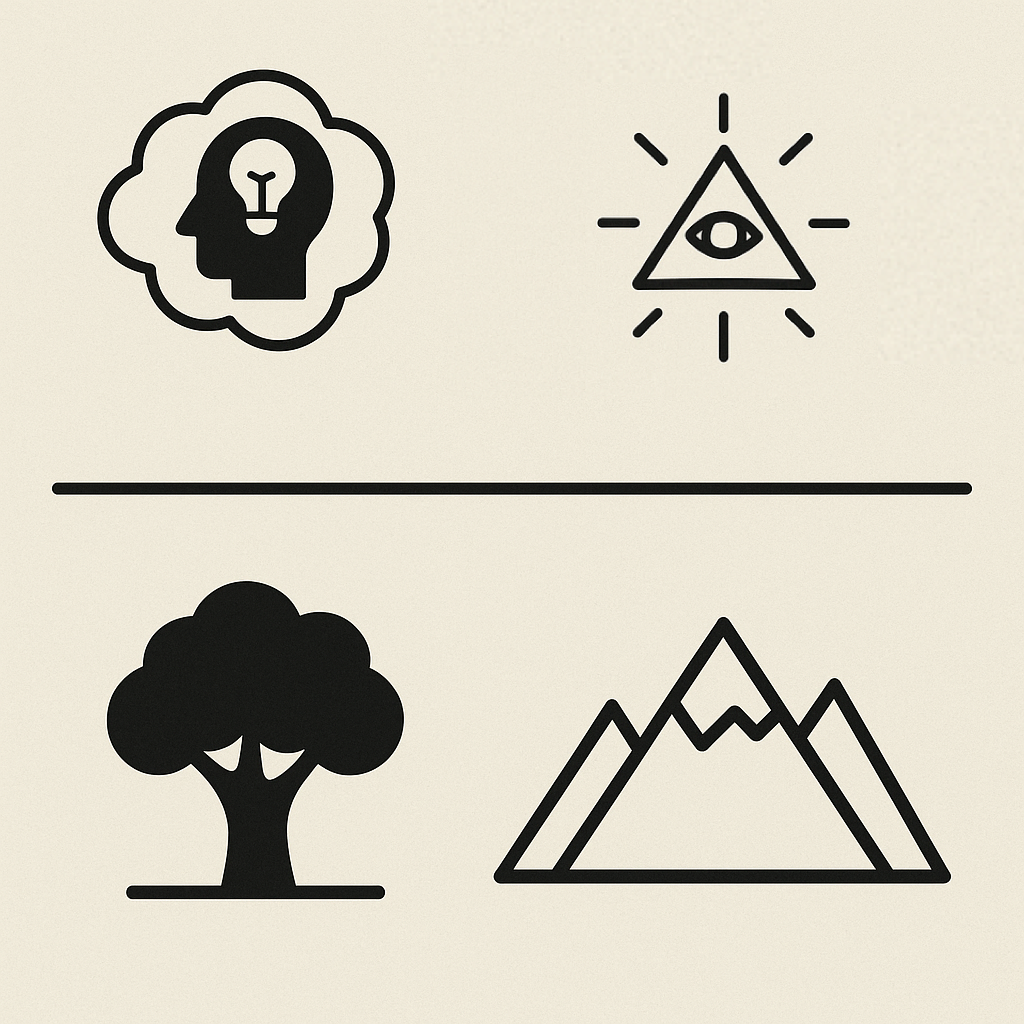
To some, sensory experience serves as the sole criterion for determining what is, was, and will be . We might, however, question the assumptions behind this worldview.
If a ball is dropped, we may measure its acceleration relative to gravity. Here we discern a fundamental relation: a falling object and an observer measuring its descent. A quick glance at the scientific method shows that all science works in this way. Something physical is taken as the standard which is then used to as a measure for similar things. Thus arise such units as the meter, the second, the gram, and so on.
When naturalists and reductionists scoff at the possibility of knowledge beyond the physical world (universals, God, the soul, etc.), they also incidentally reject the foundation by which science measures the physical world. Mathematical objects are non-physical and have non-physical standards of measure, e.g., the unit “1” (or “0”) as the basis of number. Yet mathematics is indispensable in modeling the physical world, which suggests that formal (non-physical, immaterial) structures underlie nature itself. We might even wonder whether science measures the physical at all, or perhaps the formal, non-physical structure of the physical.
But mathematics is not the only example. Consider the case of the self, the “I” of experience. The self cannot be physically observed, as every attempt to do so presumes “I” as the one observing. The situation resembles the attempt to look at the back of one’s head in the mirror: Face the mirror, and the back is hidden; turn one’s head, and the wall is seen. Any way one looks, the self is hidden, for which reason, materialists often deny the existence of the self. Yet we all know that the self is there. For who else, or what else, other than “I”, is looking?
Yet the self serves as a measure. We speak of myself, yourself, himself, and so on. Still, perhaps those who deny the existence of the self really don’t have a self. Let’s grant that. Then how do they know what they speak of, when they affirm or deny the existence of the self? For sure, language plays a part. But language also relies on meaning, which although related to the audible and visible letters and words used to speak and write, is surely something other to them.
The point is that privileging the physical, because we see it, over the non-physical, because we do not ‘see’ it, represents a narrow and distorted view of reality. Every particle of matter is akin to a letter which, when combined with others, forms words, sentences, paragraphs, and eventually the story of reality. We may read that story just as we read the story in a book. It has meaning, which transcends the ink of matter.

 Remarks
Leave a comment