
In contemporary times, the concept of fasting has become something of a trend within the dieting world. We hear of intermittent or time-restricted feeding, the 5:2 diet, alternate-day fasting, and so on. The aim in this case is to either lose weight or improve bodily health or both. In particular, the focus is physical in nature. We seek to better our bodies.
Yet fasting is a practice with a long lifeline, reaching back into ancient times. We see fasting in almost every major culture and religion—from Hinduism to Buddhism to Christianity. In this, there is the common and shared conviction that fasting has a higher spiritual purpose.
Fasting is related to the concept of abstinence, from the Latin ab- ‘from’ and tenere ‘to hold’. To abstain is to hold back from something, and abstinence is the practice of doing so.
As a form of abstinence, fasting is therefore the practice of “holding back” on food and drink. This can be practiced in various ways. For one person it may mean not drinking alcohol either at all or only on certain days (e.g., during the weekend). For another, it may mean the avoidance of certain foods, usually meat, but also dairy, oils, and other filling foods.
During the Lenten season, among Catholics and other Christians, fasting means abstaining from meat, eating smaller meals, and like practices. This reflects the Gospel where Jesus is reported to have fasted for 40 days and 40 nights in the wilderness. (Matthew 4:1-11; Luke 4:1-13) The reasons for his fast were in principle spiritual. I expect that Christ did not fast for the purpose of losing weight.
In this context, the goal of fasting, particularly during the Lenten season, is neither for physical health nor weight loss but for spiritual discipline, repentance (where fasting serves as a form a self-denial), and deepening one’s relationship with God.
It is in this sense that I would like to talk about fasting, specifically in relation to the ancient Greek philosopher Plato.
In the Phaedo dialogue, Plato characterizes the practice of philosophy in a way that is, at first glance, quite surprising. His views are spoken through the mouth of Socrates, Plato’s protagonist, who during the final hours prior to his death (from hemlock), discourses with his friends on the nature of life, death, and the afterlife. There, Socrates states the following:
I am afraid that other people do not realize that the one aim of those who practice philosophy in the proper manner is to practice for dying and death. (64a)
Some context is needed. In Book VI of the Republic, Plato details his views on knowledge and reality. Divide a line, he says, into four sections. Then the major division represents the distinction between the visible (o horos topos) and the intelligible world (o horos noetos). Alternatively, the minor portions divided reality, from highest to lowest, into:
- Ideas (or Forms)—of equality, justice, the idea of man, dog, etc.
- Mathematical objects—numbers, geometrical shapes, etc.
- Physical (visible) things—physical trees, plants, persons, dogs, etc.
- Images of physical things—shadows, reflections, paintings, works of art, etc.
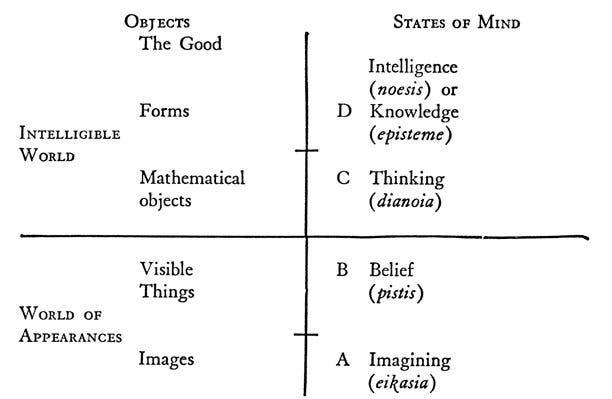
We see in the above division that the Ideas (or Forms) occupy the highest realm of being. They are also immaterial in nature.
However, Plato does not end there. He posits further a cause of knowledge. This he identifies with the Good (to agathon). The Sun serves as analogy: Just as the Sun shines on the Earth bestowing light and sustenance on physical things, so too the Good shines on the soul, bestowing the light of truth.
For Plato then, as the practice of death and dying, philosophy has the purpose of steering the soul toward higher things—the just, the true, and ultimately, the Good. But the philosopher cannot do this if enslaved to bodily desires. Seeking higher intelligible realities requires self-discipline and control. It requires a re-orientation of our desires from the physical to the higher immaterial realm.
We have in the English vocabulary the concept of the ‘ascetic’, in the sense of one who practices abstention. The word originates from the Greek askesis and askein, which literally meant ‘to train, exercise, practice’. Later thinkers such as Aristotle describe askesis according to virtue or moral excellence (arete): a disciplined practice that forms right habits of thought and action. Specifically, our lived and daily practices ultimately determine the kind of person—good or bad—that we become.
The practice of fasting is tied to this. The philosopher, in Plato’s view, fasts not for the purpose of looking good, but for the personal realization of one’s deepest desires, often obscured by the pull of the body and its wants.
In a Christian context a similar ideal is obtained. Spiritually, we fast to reign in our desires, to recognize our own impoverishment (that we depend on God), to find sympathy with the truly famished (who are forced to fast), and ultimately, to deepen our relationship with God—as the highest immaterial principle of reality (i.e, the Good).
Fasting is a way of forming ourselves morally, spiritually, and intellectually, insofar as the highest good is to be found in the highest realities.
Despite the differences, there is in fact a connection between the modern novelty of fasting and its ancient roots. Among diet practitioners, the purpose of fasting is to ‘shed pounds’. This has the effect of lightening the body. Among the ancients (and those who practice this today), fasting is also a kind of ‘shedding’ of pounds, in the sense of lightening the connection between the soul and the body. As death is (following Plato) the separation of the soul from the body, in essence, fasting is a way of preparing ourselves for death.
It is therefore not just the practice but also the purpose for which we fast which defines its utility. In both cases we will likely shed pounds, but only in the latter case —as a preparation for death—are we spiritually elevated by it. In contrast, if our aim is to just shed pounds, then the lightening of the body may lead, ironically, to the body further weighing us down. Akin to a dog led by a leash, so too is the soul led by physical desire.
I conclude with quotes from Porphyry’s Life of Plotinus. Plotinus (205-270 AD) was a Greek Neoplatonic philosopher who lived in Roman-ruled Egypt, specifically Alexandria.
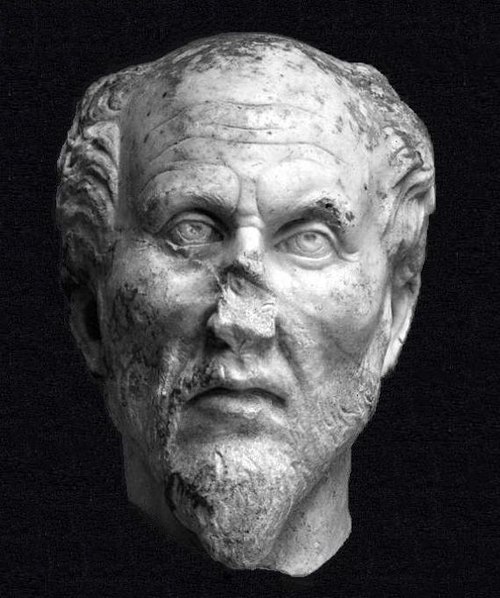
He was renowned for his philosophical lectures (passed down in The Enneads) coupled with his ascetic way of life, which included fasting, the rejection of materialistic pursuits, and related habits seen also in religious monastic communities. He exemplifies the genuine philosopher in the Platonic sense: one prepared for death and dying.
Of disdain for the body:
Plotinus, the philosopher active during our own lifetime, gave the impression of being embarrassed about having a body; he certainly could not stand talking about his race, his parents, or his original homeland.
Of the practice of fasting:
He would not agree to take medicines derived from wild animals…he did not, he said, want to derive nourishment from the bodies even of domesticated animals.
Of love of higher things:
He breathed his last with the words ‘Try to elevate the god within us to the divine in the universe’.
Of his influence on others:
Another Senator was Rogantianus who came to reject this life to such an extent that he gave up his possessions, dismissed his slaves, and resigned his position. He was due to be inducted into the office of Praetor – the Lictors were even there. But he not only refused to go on, he resigned all public office. After he relinquished the management of his own household as well, he would dine and sleep at the houses of various friends and acquaintances, only eating every other day. As a result of his renunciation and abstinence he recovered from his gout, which had been so severe that he used to be carried about in a chair; and whereas before he could not stretch out his fingers, he became more agile than craftsmen used to working with their hands. Plotinus took him into his inner circle and was full of praise for him – eventually adducing him as a good example for philosophers.

 Remarks
Leave a comment